A record of commercial rooftop solar in Great Britain, and the organisations behind it.
We have mapped the solar on Britain's commercial roofs using official registers and attributed each system to the organisations that own and occupy the buildings. Before the league table is published, every organisation can review and verify its entry.
of warehouse roof across Great Britain
of commercial and industrial roofs generate solar
rooftop solar systems mapped and attributed so far
Why rooftop solar
Rooftop solar is one of the most straightforward ways for a business to reduce its emissions. The technology is well established, its output can be measured directly, and the return on investment is well understood. It requires no additional land and uses buildings that already exist.
Because the electricity is generated where it is consumed, comparatively little is lost in transmission, and the building draws less from the grid at times of peak demand. Generating power at the point of use also avoids much of the cost of moving electricity across the network, which is an advantage over larger installations sited further from where the power is needed.
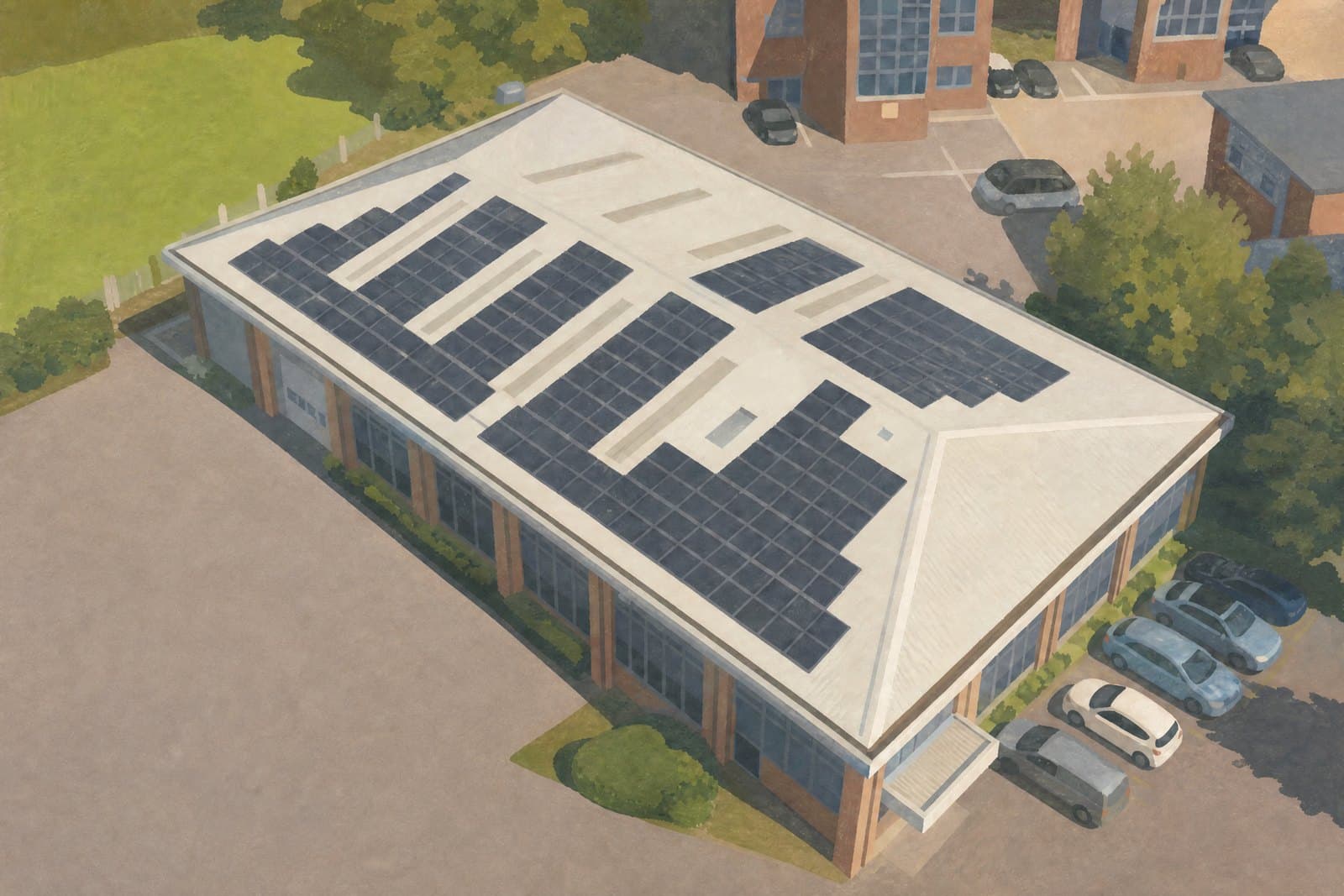
The UK's warehouse roofs alone cover more than 165 million m2. Fewer than 5% of commercial and industrial roofs currently generate solar power.
The transparency gap
Two questions that ought to be straightforward remain difficult to answer. How much commercial rooftop solar exists, and who is responsible for it. Many organisations publish net zero commitments, but the renewable generation on the buildings they control is rarely set out in a form that can be compared or verified.
The underlying information sits within official registers, spread across DNO connection data, MCS and REPD. We have brought these sources together and attributed each system to a named organisation.
Table 1: Attributed rooftop solar capacity by organisation
Illustrative extract. Placeholder organisations and figures shown ahead of publication.
| Rank | Organisation | Systems | Capacity (MW) |
|---|---|---|---|
| 1 | Example Organisation A | 64 | 38.2 |
| 2 | Example Organisation B | 41 | 24.7 |
| 3 | Example Organisation C | 29 | 17.9 |
Source: DNO connection data, MCS, REPD, HM Land Registry, Companies House. Figures illustrative.
How the league works
We compile the data from official registers, matching each recorded solar system to the landlord and occupier of the building it sits on.
Ahead of publication, we share each organisation's entry with it directly and invite confirmation or correction.
Once an entry is verified, the organisation can see how it compares with its peers.
The full league table and results are published on Tuesday 7 October 2026.
Participation is free and reviewing an entry takes only a few minutes. Where solar has been installed but not yet captured in the registers, this is an opportunity to have it recognised.
Organisation-level figures, not a property directory
We publish figures at the level of the organisation: the number of solar systems and the total capacity we attribute to each company, and where it sits in the table. We do not publish the underlying registry entries, the addresses of individual buildings, or any map linking a specific installation to a specific owner.
Built from official registers, open to correction
The league is built entirely from official registers: DNO connection data, MCS, REPD, HM Land Registry and Companies House. Every figure is dated and sourced.
Some estates are held through ownership structures that cannot be confidently resolved from public records. Where the records leave room for doubt, the entry is marked unverified until the organisation confirms it. Any organisation that considers its entry inaccurate can submit a correction.
Who runs the League
The Solar League is a non-commercial, public-interest project run by [Entity name]. It takes no payment from the organisations it lists. Basic inclusion and the right to review and correct an entry are free, and always will be.
You can reach us at hello@thesolarleague.uk.